
What is NLP and how is it used in everyday life?

How many times have you come away from a conversation thinking, “Why did I react like that again?”
You knew what you wanted to say, but ended up staying silent. Or perhaps you said something you hadn't intended to say. Maybe, faced with an important decision, you found ten more reasons to put off taking the first step.
Some of our reactions become so familiar that we barely notice them anymore.
But what if we could learn to recognise them before they happen?
These are some of the questions explored in NLP — Neuro-Linguistic Programming. It examines the ways we think, use language, create meaning and develop patterns of behaviour.
The idea isn't to become someone else, but to better understand how we function and explore different choices.
What is NLP?
NLP stands for Neuro-Linguistic Programming.
It is an approach that brings together models and techniques for exploring communication, subjective experience, and patterns of thinking and behaviour.
Its name connects three concepts:
Neuro refers to how we experience and process information through our senses and nervous system.
Linguistic highlights the role of language — not only in our conversations with others, but also in how we describe our own experiences.
Programming, in NLP terminology, refers to learned patterns of thinking and behaviour that may repeat themselves in different situations.
Sounds complicated?
Imagine two people receiving exactly the same feedback at work.
One person experiences it as criticism of their worth. The other sees it as an opportunity to improve.
The situation is the same. Yet its meaning, and the response that follows, can be completely different.
NLP invites us to explore that space between what happens and how we respond to it.

How is NLP used in everyday life?
You don't need to work in coaching, education or team leadership to find the questions explored in NLP interesting.
You simply need to communicate with other people.
1. When you want to say “no”, but say “yes” instead
A colleague asks you to take on another task. You already have too much on your plate, yet you automatically agree.
Later, you feel frustrated, perhaps even angry.
Why didn't you say what you really thought?
When exploring communication, you can examine what leads you to agree, what saying no means to you, and how you might express your needs more clearly.
You don't have to choose between being kind and setting boundaries.
You can practise being both.
2. When you've prepared for a conversation, but it takes an unexpected turn
You've already rehearsed the conversation several times in your head.
You know exactly what you want to say.
Then the other person says just one sentence, you become upset, and the conversation takes a completely different direction.
NLP communication models encourage us to pay attention to the words we choose, the assumptions we make and the questions we ask.
Sometimes, a different question can open up a more productive conversation than yet another attempt to explain our point of view.
3. When your own thoughts hold you back
“I'm not good enough.”
“I always get things wrong.”
“That's just not for me.”
Statements like these often sound like facts, even though they may simply reflect how we're interpreting our experience at that moment.
One area explored in NLP involves recognising these kinds of statements and questioning how accurate they really are.
For example, instead of saying, “I'm never good at public speaking”, we might ask:
“In which situations do I find speaking in front of others particularly difficult?”
That question won't automatically solve the problem, but it gives us something more specific to work with.
What NLP techniques can you learn?
NLP includes a variety of models and techniques, and how they are applied depends on the training, the context and the person using them.
Common areas of learning include:
Goal setting — defining more clearly what you want to achieve.
Language patterns and questioning — exploring assumptions, generalisations and the ways we communicate.
Changing perspectives — looking at situations from different points of view.
Recognising patterns — noticing recurring reactions and habits.
Modelling — studying how someone approaches a particular skill or task.
There is an important difference between being introduced to a technique and being able to apply it meaningfully.
You can memorise dozens of questions and still fail to truly listen to the person sitting in front of you.
That's why practical training shouldn't stop at explaining models.
It takes practice, feedback and space to understand when an approach may be useful — and when it may not.
Does NLP really work?
This is an important question, particularly when NLP is presented as a universal solution to almost every challenge in life.
NLP encompasses different approaches and techniques whose applications and effects continue to be explored.
A 2012 review of scientific research, published in the British Journal of General Practice, highlighted the need for further research to assess the effects of NLP interventions on health-related outcomes more reliably.
At the same time, certain NLP techniques and communication exercises may have practical value in education, personal development and the improvement of communication skills. It is important, however, to distinguish their practical use from scientifically established therapeutic effects.
That's why realistic expectations matter.
NLP training can provide an opportunity to explore your communication habits, learn models and practise different approaches. However, it shouldn't be seen as a guarantee of change or as a substitute for psychotherapy, psychological support or medical care when these are needed.
The value of training isn't simply about what someone promises you'll achieve.
It also lies in having the opportunity to ask questions, think critically and decide for yourself what is genuinely useful.
What is NLP Practitioner and where should you begin?
If you'd like to explore NLP through structured training, NLP Practitioner is the first level of NLP education.
You don't need any previous NLP training to begin.
Throughout the programme, you'll be introduced to fundamental models and techniques, explore communication patterns and develop an understanding of their practical applications through exercises.
NLP Practitioner may appeal to people who want to improve their communication and personal skills, as well as those working in education, management, entrepreneurship or other fields where working with people plays an important role.
After completing Practitioner, the next step in NLP education may be NLP Master Practitioner, an advanced level focused on connecting and applying previously acquired knowledge in greater depth.
What does NLP training look like at KORA Centre?
At KORA Centre, we see NLP as knowledge that becomes meaningful when we connect it to everyday life and work.
That's why our NLP Practitioner programme goes beyond lectures. The training includes practical exercises, demonstrations, discussions and feedback.
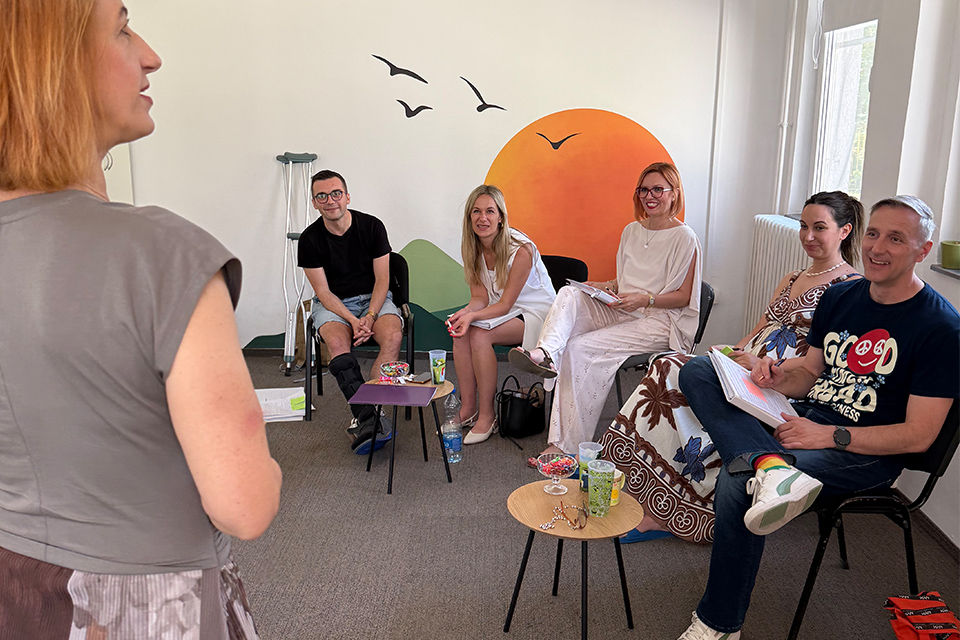
The programme takes place in person in Belgrade, runs over eight months and includes 140 hours of training.
It is internationally accredited by the NLP Global Standards Association in Canada and led by Marija Stefanovski, an educator and NLP trainer with more than 15 years of experience in educating children and adults.
Our aim isn't simply for participants to learn the names of different techniques.
We want them to understand what they're learning, explore it through experience and recognise opportunities to apply it in their lives and work.
Frequently asked questions about NLP
Is NLP the same as psychotherapy?
No. NLP training is not psychotherapy and should not be considered a substitute for professional mental health support.
Do I need previous experience to start NLP Practitioner?
No. NLP Practitioner is the first level of training and is suitable for people who are completely new to NLP.
How long does NLP Practitioner training take?
The duration depends on the training provider. At KORA Centre, our NLP Practitioner programme runs over eight months and includes 140 hours of in-person training in Belgrade.
What's the difference between NLP Practitioner and NLP Master?
Practitioner is the foundation level, introducing the main NLP models and techniques. Master is the advanced level, designed to deepen, connect and develop greater flexibility in applying previously acquired knowledge.
Sometimes change begins with a different question.
You don't have to change everything at once.
Sometimes, it's enough to recognise a recurring reaction, pause and ask yourself whether there's another way to respond.
If you'd like to explore NLP through structured training and practical learning, discover our NLP Practitioner programme at KORA Centre.
Perhaps that's where your next step begins.